UB Scholars Bring African Perspectives to Global Bioethics Debate
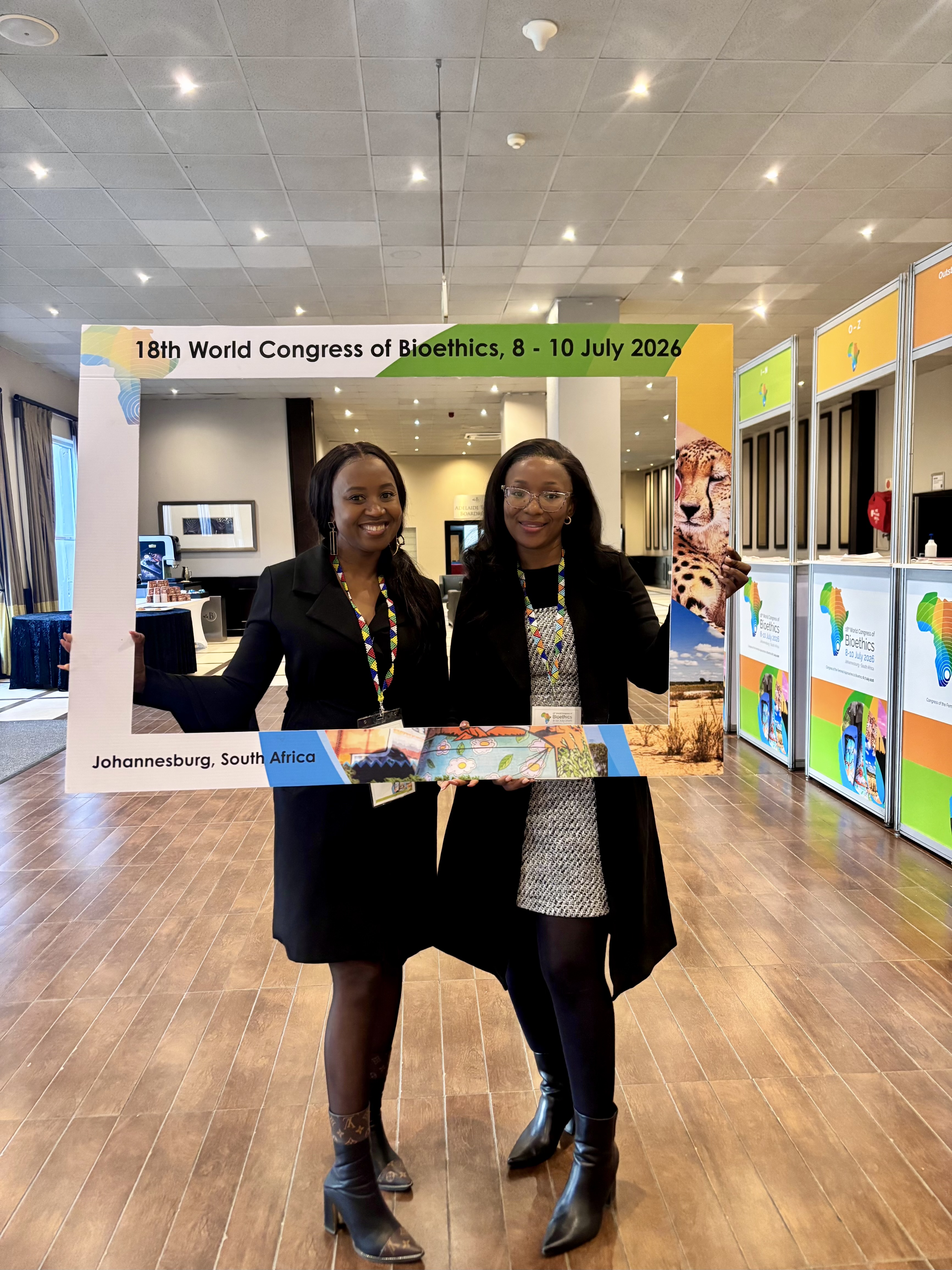 University of Botswana scholars contribute to global conversations on ethical AI, research governance and health equity at the World Congress of Bioethics.
Scientific innovation is advancing at remarkable speed but the ethical questions surrounding that progress are becoming equally complex. Who benefits from new technologies? Whose data informs artificial intelligence? How can researchers protect participants while ensuring that important scientific discoveries are not unnecessarily delayed? These questions are increasingly shaping the global debate on bioethics and responsible innovation.
The University of Botswana (UB) contributed to this important conversation through the participation of two scholars at the 18th World Congress of Bioethics, held in Johannesburg, South Africa, from the 8th – 10th of July 2026. Held under the theme “Comforting and Disturbing Bioethics,” the congress brought together bioethicists, healthcare professionals, researchers, policymakers and regulators from around the world to examine emerging ethical challenges in medicine, science and public policy.
Among the UB participants were Dr Dimpho Ralefala, Head of Research Ethics and Integrity and Ms Ludo Wilson, Senior Professional for Biomedical Research. Their contributions reflected two (2) complementary dimensions of bioethics: ensuring that emerging technologies such as artificial intelligence are developed and used fairly and strengthening research governance systems so that ethical safeguards protect participants without unnecessarily constraining scientific progress.
Dr Ralefala presented “Artificial Intelligence for Global Health Equity: Navigating Data, Justice, Responsibility and Ubuntu in Low- and Middle-Income Countries.” Her presentation examined the ethical implications of using artificial intelligence in global health particularly in low- and middle-income countries. Drawing on the Belmont Principles and the African philosophy of Ubuntu, she highlighted the need for shared responsibility among governments, technology developers, funders and researchers to ensure that AI contributes to health equity rather than deepening existing inequalities.
She noted that artificial intelligence was rapidly becoming a major ethical issue in global health and stressed that it should not be viewed simply as a technical matter. Questions of justice, fairness, responsibility and inclusion must also be considered. For Botswana, this is particularly relevant as AI increasingly finds applications in healthcare, research, data management and decision-making.
Dr Ralefala emphasised the importance of strengthening Botswana's health data systems, ethical governance and local expertise to ensure that emerging technologies respond to local needs and do not reproduce biases arising from incomplete or externally generated data. She also called for greater African participation in international discussions on AI ethics and governance.
Ms Wilson's contribution focused on research governance and the balance between ethical protection and scientific progress. Her poster presentation, “Gatekeeping Ethics? Unseen Barriers to Equitable Research in Global Health Governance,” used Botswana's research ethics governance system as a case study to examine how multiple ethics review and permitting requirements can sometimes create administrative burdens for local researchers, postgraduate students and smaller research organisations.
Ms Wilson's work does not advocate weaker ethical oversight. Instead, it calls for systems that maintain rigorous protection of research participants while reducing unnecessary administrative barriers and enabling high-quality, locally led research to progress more efficiently.
She observed that issues such as AI, data justice, global health equity and research governance were increasingly interconnected and require African perspectives. For Botswana, effective research governance is particularly important as the country seeks to strengthen its research capacity and ensure that local researchers and communities participate meaningfully in the generation and application of knowledge.
The participation of the two UB scholars at the congress demonstrates the University's growing contribution to international conversations on research ethics, responsible innovation and global health governance. It also reflects UB's broader commitment to becoming a research-intensive institution whose scholarship contributes to solving societal challenges.
Their work highlights an important principle: scientific progress should not be measured only by what technology or research makes possible, but also by how responsibly, fairly and inclusively that progress is achieved. By bringing African experiences and perspectives into global bioethics discussions, UB scholars are contributing to the development of approaches that seek to advance innovation while protecting human dignity, equity and public trust.