Prof Norris Challenges Africa to Turn Education into Nation Building Through Innovation, Integrity
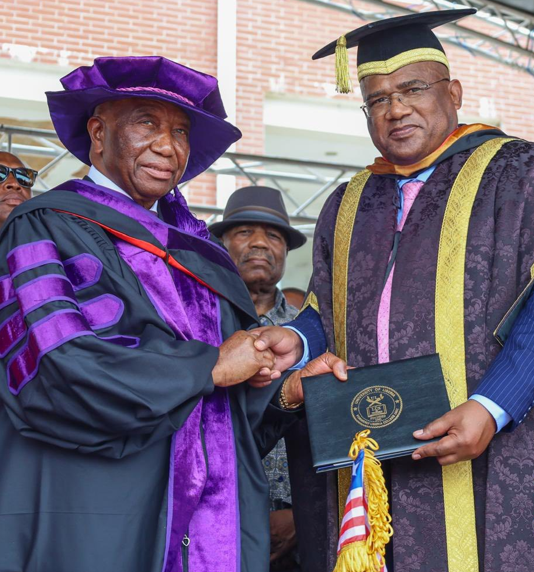 Across borders and histories shaped by struggle and renewal, the University of Botswana (UB) continues to play a meaningful role in Liberia’s rebuilding journey working closely with the University of Liberia (UL) and key actors within the country’s education system.
This enduring academic partnership reflects a deeper Pan-African commitment to shared growth, reconstruction and continental solidarity. It was within this spirit of collaboration and mutual purpose that UB Vice Chancellor, Professor David Norris, was invited to deliver the keynote address at the University of Liberia’s 105th Graduation Ceremony on the 27th of February 2026, a moment that placed both institutions and the continent they serve at the centre of a shared conversation about Africa’s future.
That commitment was powerfully underscored in Monrovia, in a ceremony attended by national leaders including Liberian President Joseph Nyuma Boakai, Sr.
Ahead of his address, Professor Norris was conferred with an Honorary Doctor of Agricultural Science degree in recognition of his outstanding service to humanity particularly in agriculture and for his continental standing as a scholar and advocate of African university collaboration, research excellence and agriculture-led development.
When he rose to the podium, Professor Norris made it clear that his address was not ceremonial rhetoric but a call to action and using Liberia as a mirror through which Africa could confront its shared challenges.
“Today is not merely a ceremony,” he told the graduates. “It is a declaration - a declaration that the future of Liberia is alive, educated and ready; that hope is stronger than hardship.”
He situated Liberia at a defining historical moment, noting that, like many African nations, it was richly endowed with natural resources, resilient people and a youthful population. Yet these strengths, he argued, continued to be undermined by structural economic weaknesses, uneven growth, infrastructure gaps and persistent debt pressures. Turning directly to the graduates, Professor Norris challenged the familiar narrative that positions them simply as “the future.” Instead, he urged them to become builders, innovators, ethical leaders and problem solvers because Africa, he said, no longer needed spectators. In a candid critique that resonated far beyond Liberia, he highlighted Africa’s long-standing dependence on exporting raw materials, a pattern that continued to externalise jobs, profits and technological learning.
“You sell raw rubber instead of finished tyres. You export cocoa beans instead of chocolate. You ship iron ore instead of steel products. You export palm oil but import finished goods at higher prices,” he observed.
Through these examples, Professor Norris illustrated how Africa forfeits billions of dollars by failing to invest in value chains, stressing that local processing, packaging, branding and innovation were not optional but survival strategies.
He further argued that Africa’s development challenges were not only technical but moral. Corruption, nepotism and short-term thinking, he said, eroded resources, undermined merit and sacrificed long-term prosperity.
Drawing from his background as a geneticist, Professor Norris rejected any notion of intellectual inferiority, stating unequivocally that there was no genetic difference in intellectual capacity between races. Africa’s challenge, he maintained, lies not in ability but in attitudes, work ethic, distorted mindsets, entitlement and a persistent failure to collaborate.
“These,” he warned, “are compounded by pettiness, unhealthy competition and poor, unethical leadership.”
In one of the address’ most striking passages, he cautioned that skills without integrity were dangerous, education without ethics is hollow while leadership without accountability was destructive. While directed at the University of Liberia’s graduating class, the message resonated as a continental challenge: that Africa’s graduates must become authors of a new chapter. One defined by agricultural processing zones that employed thousands, digital start-ups exporting services globally, local industries manufacturing what was once imported and research institutions shaping evidence-based policy.
In invoking Liberia’s past, present and future, Professor Norris ultimately articulated a Pan-African vision - one in which African solutions are built by Africans, for Africa, grounded in integrity, collaboration and purposeful leadership.