Minister Urges Newly Constituted UB Council to Fast-Track Reforms and Drive Transformation
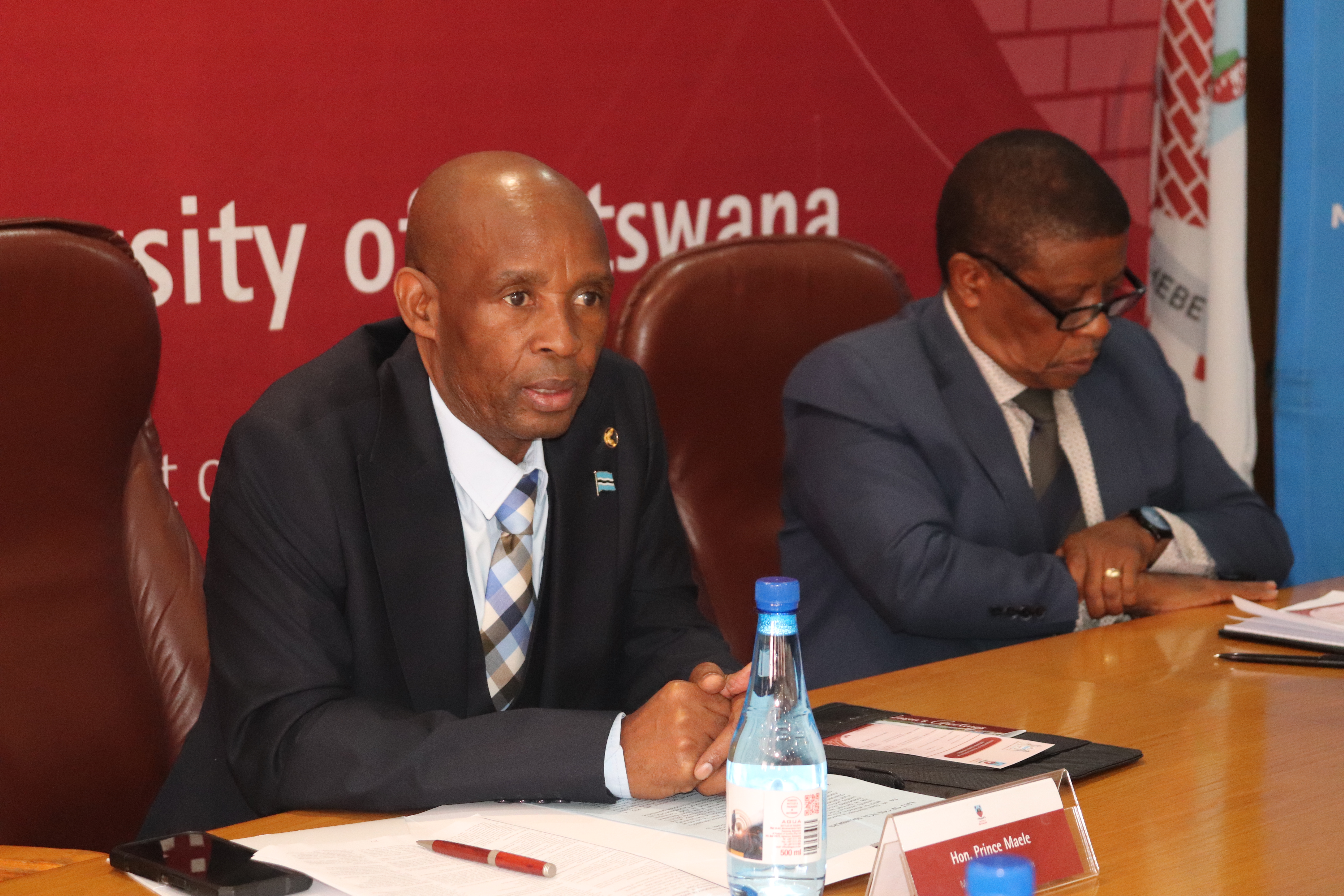 The Minister of Higher Education, Hon Prince Maele, has called on the newly reconstituted of the University of Botswana (UB) Council to move swiftly in addressing outstanding matters and restoring institutional momentum.
Minister Maele was addressing a meeting convened to introduce nine (9) newly appointed Council members. He acknowledged that for nearly a year the Council was unable to function fully due to its incomplete composition, resulting in delays on key governance and strategic processes. Among the affected matters, he said, were the University’s annual report and most critically, the organisational restructuring exercise which had taken an unusually long time to conclude.
Against this background, the Minister emphasised that the first quarter of 2026 would be pivotal, calling on the Council to double down and ensure that all outstanding issues were addressed as a matter of urgency. He further cautioned members against conflicts of interest, advising them to refrain from interfering in operational matters and instead focus on providing strategic oversight and direction to University management.
Looking ahead, Minister Maele outlined several priority areas for the Council including steering the transformation of UB into a fourth-generation university driven by impactful research and innovation. He also called for amendments to the University Act to align it with emerging trends in higher education. He stressed that the era of universities functioning solely as teaching and learning institutions was over, urging UB to strengthen third-stream income generation to mitigate declining government funding. The Minister encouraged the new Council members to participate actively in Council business and to add tangible value to the institution.
Earlier, in welcoming the Minister, UB Council Chairperson, Dr Daniel Tau, expressed gratitude that the Council was now properly constituted and ready to commence its work. Dr Tau noted that the nine-month hiatus in Council meetings had significantly disrupted operations, with several planned projects unable to proceed. He agreed with the Minister that the first quarter of 2026 would be particularly demanding, requiring members to work diligently to get the University back on track.
Vice Chancellor, Professor David Norris, also welcomed the reconstitution of the Council, describing it as a turning point that would allow stalled processes especially the restructuring exercise to move forward.
Professor Norris explained that while the restructuring had taken time, it was necessary to align the University with its evolving strategic direction. He noted that UB was now firmly positioned on a transformation path towards becoming a High-Performance Organisation (HPO) anchored on research and innovation.
The Vice Chancellor further highlighted key progress made during this period of transition including efforts to rein in the wage bill which previously consumed as much as 92 percent of the University’s budget. He also pointed to UB’s improved research standing, noting that the institution had moved from 11 to 65 in global research rankings, an achievement that, he said, r einforced confidence in UB’s capacity to deliver impactful research on the global stage.
Speaking on behalf of the newly appointed members, Dr Shabani Ndzinge expressed gratitude for the appointments and assured the Minister of the Council’s commitment to hard work, value addition and contribution to national development and the international community.
In his closing remarks, Permanent Secretary in the Ministry of Higher Education, Professor Richard Tabulawa, also welcomed the full constitution of the Council, explaining that the appointment process took time due to the rigorous procedures involved in identifying suitably qualified individuals.